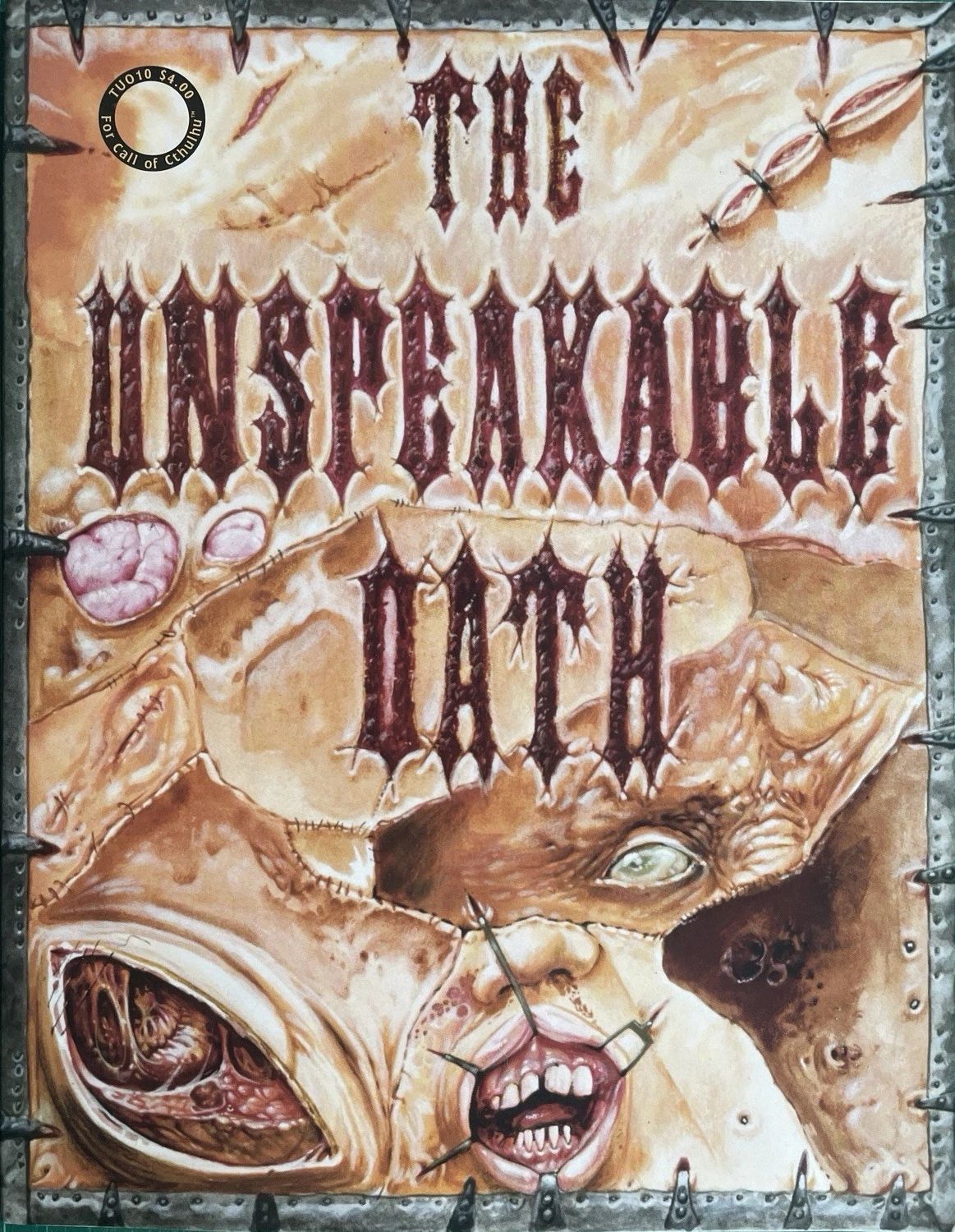
IN MEDIAS RES is a short modern-horror scenario (‘adventure’ is the wrong word for it) by John Scott Tynes, originally designed for Cthulhu Now and first printed in The Unspeakable Oath issue 10 in 1993. It was reprinted in The Resurrected #3 – Out of the Vault in 2003. Thirty years after its publication, it still lives up to its reputation as an unflinching piece of modern horror RPG design that’s genuinely horrific.
Normally at this point we’d link to a site where you can acquire the material we’re discussing, but ‘In Medias Res’ is not only out of print, the two books it’s appeared in are rare, so you’re probably out of luck. Shane Ivey has confirmed that Arc Dream will reprint it in Shotgun Scenarios, due out in a few months, but meanwhile you can try Noble Knight for TUO 10 or Resurrected 3, or eBay.
“The fact that this is from before safety tools is like those cars in the early days,
before they invented brakes” – Greg
Thanks to Shane Ivey of Arc Dream Publishing for his support of the podcast and this episode in particular.
SHOW NOTES
These are the notes for this episode, a chance for us to pick up the threads, fill in the blanks, throw up some links, and correct the occasional errors that we didn’t have time to deal with in the episode itself. Yellow text is a clickable link.
Spoiler notes: this whole episode is a massive spoiler for the scenario, and if you think you might ever play through it then you probably shouldn’t listen to this or read these notes. If you think you might run it, on the other hand, then go for it, by all means, don’t let us stop you. Also there are spoilers for James’s game Alas Vegas.
‘In Medias Res’ translates as ‘in the middle of things’, describing a narrative that begins in the middle of the story, not at the chronological start. It’s an ancient technique: both the Mahābhārata and the Odyssey open on scenes long after the hero started their journey, and the first use of the term itself comes from Horace’s Ars Poetica (c. 13 BC). This scenario was originally published in TUO as ‘In Media Res’ but the title was corrected for the reprint. (In Latin, adjectives agree with the noun they’re associated with, so because ‘res’ (things) is plural, ‘medias’ should be too.)
To clear up any confusion, John Scott Tynes was known as John Tynes in the 1990s and took his wife’s name as a compound when they married in, as I recall, the mid-2000s. It is not some kind of tribute to Adam Scott Glancy.
‘Proto-chamber-larp’: a chamber larp is a cut-down form of live-action roleplay, usually played in a short session of a few hours, in a small physical space that may be a single room. The format has been around since the early 2000s. A similar idea is the black box larp, played in a space with monotone walls, no windows and minimal or no furniture, the idea being that the constraints enable the imagination, not restrain it
Greg suggests that the artist Anson Maddocks would have paused parking trucks full of Magic money to take time to paint the cover for TUO 10. Given that TUO 10 was a fall release in 1993 and Magic wasn’t released until mid August that year, this seems unlikely.
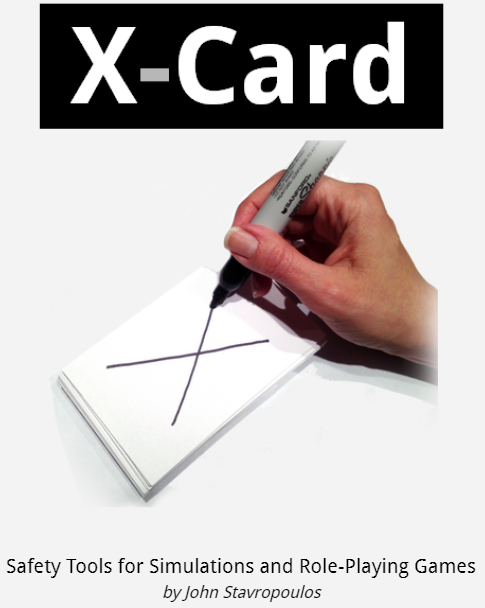 ‘Before the X-Card was invented’: the X-Card is a safety tool for RPGs, whereby any player who feels uncomfortable with the direction of play, for any reason, may simply tap the X-Card on the table, and the other participants will rewind or change the direction of the game. It was created by John Stavropoulos in 2013, originally for convention play and games with strangers, but he open-sourced the whole thing and it has been taken up by publishers including Evil Hat, Monte Cook Games, Roll20, and even Wizards of the Coast (in 2021’s Van Richten’s Guide to Ravenloft, which Stavropoulos worked on.) You can read the original 2013 X-Card document here.
‘Jailbreak’ is Greg’s related modern-horror adventure for Unknown Armies, written in 1998. Greg co-created Unknown Armies with John Scott Tynes. ‘Jailbreak’ is a very different adventure, though it starts from a similar place as IMR. We covered it earlier this season, in episode 14.
We mention that the adventure in ‘the Delta Green quickstart’ is also a remote-farmhouse adventure, though actually it’s more of a cabin-in-the-woods. The adventure is ‘Last Things Last’ in the Delta Green: Need to Know free starter rulebook, a free download from DriveThruRPG. It was written by Brett Kramer as part of the Delta Green shotgun scenario competition, which we refer to later in the episode, and it’s pretty tight. Worth a look, and you can’t beat the price.
Nordic Larp – if you want to know more of the history of the Nordic Larp form, the book Nordic Larp is an amazing read and also a free download.
Cthulhu Now was a 1987 supplement for Call of Cthulhu, updating the game’s setting to the present day, or at least to the late 1980s, which might as well be the ancient past by now (no internet, no mobile phones, computers with less than a megabyte of memory, no Marvel Cinematic Universe, only one senile former media star re-elected as US president, RPGs still considered uncool.)
Discussing games built around the amnesia trope (meaning PCs begin the game with no memories), we forgot to mention the great antecedent of the genre: Sandman, Map of Halaal (Pacesetter,1985), a bold attempt to create a pick-up-and-play RPG that almost worked. Planned as a series of ten boxed sets that would build into an epic campaign, only the first was ever released, and the answer to the $10,000 competition (who are the PCs?) was never revealed. James remains quietly obsessed by it. Ridiculously cheap today, it’s a fascinating dead-end in the ongoing quest to design a better way to present an RPG.
 Psychosis: Ship of Fools, was another early amnesia-game, written by John Fletcher and Charles Ryan, and released in 1993 by Chameleon Eclectic. It’s also noteworthy for being one of the first games to use tarot cards instead of dice. It had a sequel: Psychosis: Solitary Confinement.
Discussing ways that RPGers in the 1980s and early 1990s shared ideas and discovered what was happening in terms of game-design trends, apart from the thin crop of RPGs that paid any attention to this sort of thing, there were APAs, like communal fanzines where members submit zines to a ‘central mailer’ who compiles them and sends them out, and Usenet, which was like Reddit but unmoderated, text-only, full of spam, and yet somehow not as bad. In 1994/5 there was Interactive Fantasy, the quasi-journal that James published, but in the years before PDFs it wasn’t easy to find copies.
‘An hour is golden, but it is not an hour’ is a quote from Puppetland.
The Latin for “to come to a conclusion” is apparently “ad conclusionem pervenire”.
 The typeface ITC Machine, which James refers to, is instantly recognisable from the Space Invaders logo and the Top Gun poster, among many other things. James over-uses it.
3:16 Carnage Among the Stars is a small but incredible RPG by Gregor Hutton from 2008. Coming on like a cross between Starship Troopers and Warhammer 40,000, it delivers one of the great SF-combat game experiences. Absolutely worth $10 of your money.
We mention the trend of transgressive horror in the 1980s and 1990s: Clive Barker is of course the poster-child for this sort of thing, but we should also mention NEKRomantik, the 1987 75-minute widely banned opus by Jörg Buttgereit and, at the other end of the scale, the increasingly mainstream career of David Cronenberg, who went from making The Brood to Dead Ringers in less than ten years.
Threads is a BBC TV film from 1984 depicting a nuclear strike on the post-industrial Midlands town of Sheffield. It is startling in its bleak realism. The BBC showed it twice in the mid-1980s and then not again until 2003 despite its critical reputation (it won four BAFTAs) and the scars it had left in the memories of the British populace. Similar but comparatively lighter, The Day After was broadcast in the USA the year before.
‘Catharsis’ comes from Greek drama. It literally translates as ‘purging’, but in his Poetics Aristotle recast it in a mental mode, relating to the emotional release from climax – the moment that tension is released in a story: the direction may be positive or negative but the unknown becomes a known, the uncertainty is made certain.
Stardew Valley is a 2016 video game created by solo-designer Eric Barone. Firmly in the tradition of earlier farming simulators like the Harvest Moon series, it depicts the travails of a young person who inherits their late grandfather’s dilapidated farm, close to a cosy community. It has sold over fifty million copies.
The Prince Charles Cinema is London’s leading independent second-run and arthouse cinema, with a programme that runs the gamut from Buster Keaton to Hundreds of Beavers, via Singalonga K-Pop Demon Hunters, director retrospectives, and (inevitably) The Room. James has not one but two lifetime memberships, because of reasons.
Rashomon is Akira Kurosawa’s classic, brilliant 1950 film of multiple unreliable narrators, starring Toshiro Mifune. Could you run it as an RPG? Greg’s ‘Star Chamber’ adventure for Delta Green gets pretty close to that format of overlapping and contradicting retellings. I think an RPG adventure where things go wrong and people die, and then a month or so of real time later the PCs find themselves in front of a court and have to recall the details and answer questions without hearing what the others say (or there are NPCs who remember it differently, with more or less accuracy)… there’s potential there.
Ross has inevitably run ‘Star Chamber’ with Caleb Stokes among the players (it’s mentioned in the episode) in a single Roleplaying Public Radio two-hours-thirty session, and you can listen to it in all its glory here.
Thank you for listening! The hosts of this episode were Ross Payton, Greg Stolze and James Wallis, with audio editing by Ross and show notes by James. We hope you enjoyed it. If anything in this podcast or these notes has spurred your interest then we invite you to come and chat about it on our friendly Discord.
If you click on any of the above links to DriveThruRPG and buy something, Ludonarrative Dissidents will receive a small affiliate fee. You will not be charged more, and the game’s publisher will not receive less, it’s a win-win-win. Thank you for supporting the podcast this way.