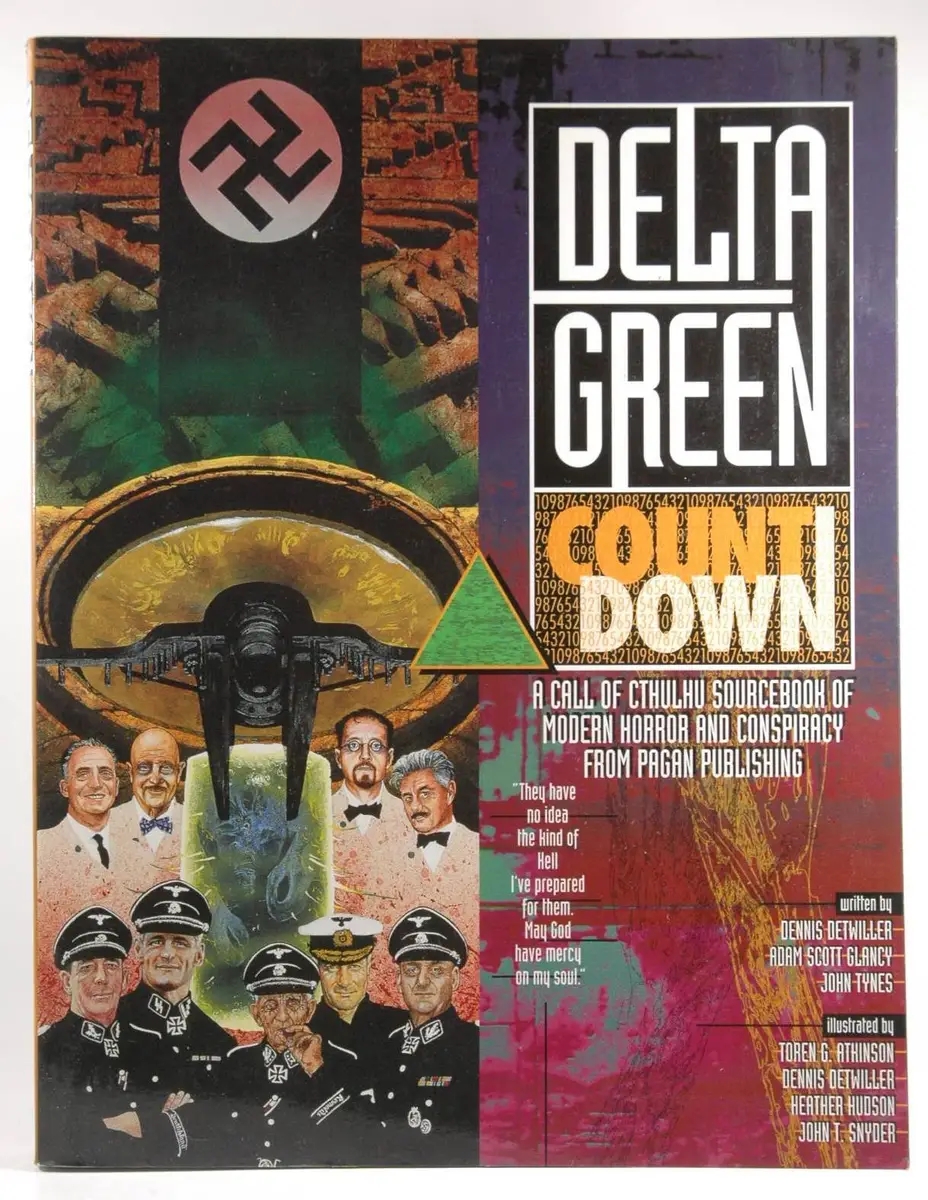
click image for full cover
DELTA GREEN: COUNTDOWN is a supplement for the Call of Cthulhu RPG, written by Dennis Detwiller, Adam Scott Glancy and John Tynes, and originally released by Pagan Publishing in 1998. In this episode we discuss the digital version of the second printing, which is the most widely owned one, and the one available for sale today. A revised and updated version of the book is apparently in the works, but don’t hold your breath.
- Delta Green: Countdown at Wikipedia
- Delta Green: Countdown at DriveThruRPG
- The Delta Green game-line at DriveThruRPG
“It was a simpler time of punching Nazis, not electing them” – Greg
Spotify will only let us embed a preview, so click through to the full recording.
This episode of Ludonarrative Dissidents is brought to you thanks to Ethan Cordray of the Technical Difficulties gaming podcast, an actual-play podcast featuring a wide variety of systems including Delta Green and many other RPGs featured on Ludonarrative Dissidents. Visit technicaldifficultiespod.com or search on your podcasting app of choice to find the episodes. Huge gratitude to Ethan and all the other supporters who make our podcast possible.
SHOW NOTES
These are the notes for this episode, a chance for us to pick up the threads, fill in the blanks, throw up some links, and correct the occasional errors that we didn’t have time to deal with in the episode itself.
Pagan Publishing, the original home of Delta Green: Countdown, no longer exists and in fact you can buy the domain paganpublishing.com if you have $13,000 burning a hole in your pocket. The Delta Green game line and its co-creator Dennis Detwiller are now with Arc Dream Publishing. However Pagan was always incredibly strong on creators’ rights, and it is a near certainty that if you buy Countdown or any other Pagan product today, the money will go to the people who wrote and illustrated it.
Other WWII Cthulhu games are available:
- Achtung! Cthulhu from Modiphius (apparently “a band of Allied heroes fight the Secret War against the Nazi Black Sun and their rivals Nachtwolfe”) is a line that includes an RPG, minis games, graphic novels and more. Pulpy fun.
- World War Cthulhu, originally from Cubicle 7, is now owned by Chaosium after C7’s licence to publish Call of Cthulhu supplements expired. More grounded than Achtung!, not currently in print apart from a fiction anthology including takes from Robin Laws, Sarah Newton, Lavie Tidhar, and Greg Stolze of this parish.
- Weird War II is part of Pinnacle’s Weird Wars series for Savage Worlds and as the name suggests covers more weirdness than just the Cthulhu mythos.
- Cthulhu Eternal – World War II is an SRD for a largely open-source Cthulhu-based system that owes a fair bit to Call of Cthulhu. It’s pay-what-you-want, which seems fair.
Adam Scott Glancy is one of the co-creators of Delta Green. He left a career as an attorney to join Pagan Publishing in the late 1990s, and became its president after John Tynes left the company and the RPG biz in 2001. If you ever get the chance to have a drink with him, take it.
PISCES, MI–13, the ‘Special Reconnaissance Section’ agency of British Intelligence, is fictional and if the British espionage/counter-espionage community has ever had any dabblings with the eldritch or occult then the details remain well hidden. However, anyone interested in real-world Special Reconnaissance Sections will probably enjoy this declassified document from the CIA, concerning a 1985 lecture at the Voroshilov General Staff Academy on the subject of agent reconnaissance in support of military operations.
Gurkhas are Nepalese and North Indian soldiers who fight with a variety of forces, notably the British Army. Twenty-six soldiers in Gurkha regiments have won the Victoria Cross. They are associated with the khukuri, a distinctive forward-curving knife, and have what Wikipedia describes as “a reputation for fearless military prowess” or, as my father advised me, don’t ever mess with a Gurkha.
Lovecraftian ghouls are descended from the ghouls of legend, notably Arabic folklore; the term entered English in 1786 in the Orientalist novel Vathek. Traditionally they are a type of jinn, beings with occult power, who dwell in caves and cemetaries, and kill and eat humans. Lovecraft’s ghouls are a subterranean race whose diet of the flesh of corpses has changed their physical make-up, though they retain their intelligence. This has become the generally accepted modern version of the ghoul. Why the D&D creators made their ghouls undead is unclear.
Hastur, ‘the unspeakable one’, is not a creation of H P Lovecraft. It first appears in a short story by Ambrose Bierce in 1891, ‘Haïta the Shepherd‘, from whence Robert Chambers borrowed it for the King in Yellow stories (see below). Lovecraft only mentions Hastur twice, both times in ‘The Whisperer in Darkness’, as an enemy of the Outer Ones. It was August Derleth, founder of Arkham House and coiner of the term ‘Cthulhu mythos’, who developed Hastur into an elder god, Cthulhu’s half-brother, and all of that.
James refers to type sizes, talking of 9-point and 7.5-point. You’re probably familiar with this idea from software such as Word, though you may not know its origins. A ‘point’ is a twelfth of a pica or one-72nd of an inch (0.3527mm) and dates from the Italian typographer Francesco Torniella da Novara in 1517, though its precise size was not generally agreed until 1984. That is not the reason that 12pt type can wildly in size between different typefaces.
Type size is an important factor in readability, though trying to find any standards or even standard advice on this is hard. Further confusing things is the difference between viewing text on paper and text on screen. The University of Cambridge has a very good Inclusive Design Toolkit, drawing on principles from the European Accessibility Act, and if you’re designing books or websites it will give you a grounding that many guides on graphic design miss out completely.
Don’t make me explain the difference between typefaces and fonts again.
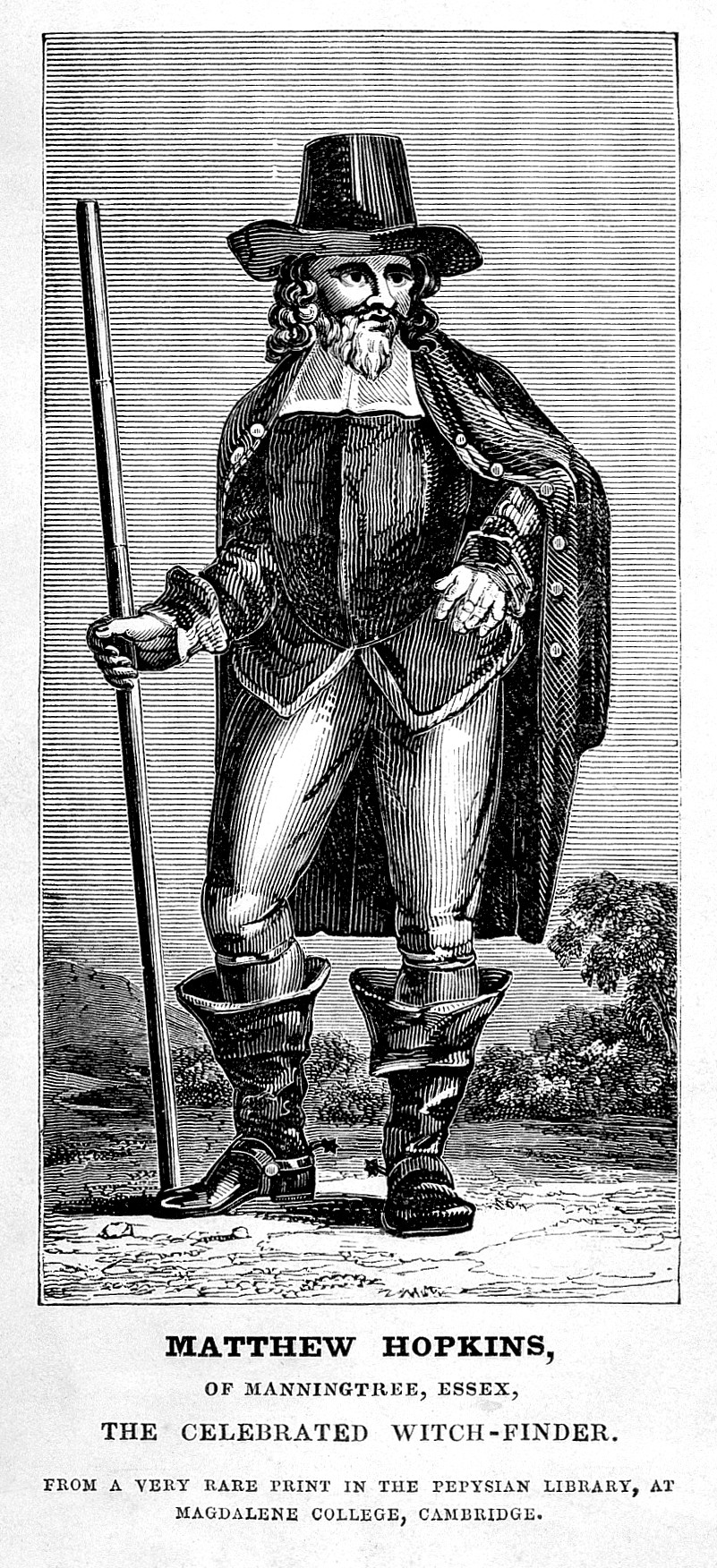 Matthew Hopkins, the self-styled Witchfinder General, was born in Suffolk around 1619, an area that at the time was strongly Puritan. After his associate John Stearne accused twenty-three women of discussing their meetings with the devil in March 1644, Hopkins became his assistant. A year later nineteen of the women were hanged (four had died in prison) and the two men had a lucrative new career. It’s important to note that the English Civil War was at its height, and at the time these were almost the only trials for witchcraft anywhere in the UK. Over the next three years, until his retirement and death in 1647, Hopkins was responsible for the trial and execution of at least a hundred ‘witches’. Later, methods from his book The Discovery of Witches were used in New England to prosecute around eighty people, mostly women, of witchcraft between 1648–1663, and subsequently in the Salem Witch Trials.
Ramsey Campbell is a British horror writer who has contributed elements to the Cthulhu mythos, including Goatswood, the Shan insects, Gla’aki and the occult tome The Revelations of Gla’aki. In particular his work on the Severn Valley and the Shan is heavily referenced in Countdown.
Lisa Padol, who appears vicariously in Countdown, is a longstanding RPG writer who has done work for Chaosium, Arc Dream and Pelgrane Press, among others. She is staff editor at Golden Goblin Press.
The Tynes Effect is the assumption by fans and readers that RPG material produced by Pagan Publishing or Arc Dream, was primarily created by John Tynes. We’ve discussed it before.
James mentioned Bizarre magazine, which no longer exists, and Fortean Times, ‘the foremost journal of strange phenomena’, which still does. Both covered weird culture, cults, sightings and oddities, but Bizarre was more focused on people. Both had interesting post-bags. Both were published by John Brown Publishing in the 1990s; Bizarre originated there, but FT was originally self-published in the 1970s by Bob Rickard and Paul Sieveking, who were later joined by Steve Moore (better known as a comics writer and I Ching expert) and Mike Dash, who were known as the ‘gang of Fort’. James first met Dash at Loch Ness in the summer of 1983, which is partly how he ended up as Bizarre‘s managing editor.
Talking of magazines, ‘pulpy’ is a term derived from ‘pulp magazines’, a genre of genre-fiction magazine that were popular 1900–1960, taking their name from the cheap woodpulp-derived paper they were printed on. ‘Pulp fiction’ has come to denote a style of lurid action-packed adventure, usually horror, detective fiction, western, SF or some fantasy, strong on pugilism and testosterone, often in serial form. The stories of many notable writers including Lovecraft, Robert E Howard, Zane Grey, Raymond Chandler and Isaac Asimov were first published in pulp magazines.
‘Secrets of the Kremlin’ is a Call of Cthulhu adventure written by E. S. Erkes and first published in 1984 as half of the supplement Glozel est Authentique! by Theatre of the Mind Enterprises (TOME). It was not well reviewed when it came out, and time has not improved its reputation. Copies sell for around $60.
Chaosium has changed hands, management and editorial direction several times in its history. It was originally founded in 1975 by Greg Stafford to publish his fantasy boardgame White Bear and Red Moon, followed by Steve Perrin’s Runequest in 1978 and Sandy Petersen’s Call of Cthulhu in 1981. In the mid-90s the company ran into financial difficulties relating to its CCG Mythos and management passed to longtime employees Lynn Willis and Charlie Krank. Stafford and Sandy Petersen rejoined Chaosium in 2015, and shortly afterwards a stake in the company was acquired by Moon Design Publications, which had been a longtime Runequest licencee. The company is now run by Jeff Richard and based in Ann Arbor, Michigan. Lynn Willis died in 2013; Greg Stafford in 2018; Steve Perrin in 2019, giants all.
The idea of Nazi occult scientists summoning Deep Ones and dabbling in the Cthulhu mythos, and subsequently being grabbed by Russians and Americans at the end of WWII as part of Operation Paperclip, referenced by Ross, is not new and most notably appears in Charles Stross’s 1997 short story ‘A Colder War’.
Pagan Publishing was founded in 1990 by the then-19yo John Tynes, to publish the CoC fanzine The Unspeakable Oath. As well as the magazine and anthologies based on its articles, Pagan released thirteen CoC supplements, eight Delta Green books, five fiction anthologies and a few other games and books. From 1994 the company was based in a house known as Pagan House in Seattle, where most of the principal creatives lived. Both James and Ross stayed at Pagan House and were changed by the experience.
Blair Reynolds was an artist for Pagan Publishing and other RPG and fantasy game companies, noted for his highly detailed, meticulously executed artwork. The cover of Countdown is a good example of his style. He was interested in pushing the boundaries of Lovecraftian material with a particular emphasis on the sexual and grotesque, which resulted in more than one Pagan book being banned from sale at Gen Con. He died of heart failure in 2021, aged 59.
Taking regular breaks is, as Greg says, an important ways of maintaining physical and mental health for people who work intensively on text or art. However the reason they often work so intensively is due to ADHD hyperfocus, which is not compatible with regular breaks or regular anything, and is endemic among RPG creators. Nevertheless, take breaks: set an alarm on your phone or use a pomodoro timer to remind you. And if you have wrist pains that you think may be due to carpal tunnel syndrome or repetitive strain injury, try a vertical mouse. It’s cheaper than surgery.
William Faulkner’s 1930 story ‘A Rose for Emily’ (not ‘Miss Emily’ as we said in the episode) was his first publication in a national magazine. A southern gothic tale about a reclusive woman, it is not a conventional horror story, but that does not prevent it being horrific.
Ross states that “Lovecraft was a racist”. It is beyond dispute that Lovecraft was not just a racist but a white supremacist, and we have no truck with anyone who tries to deny or justify his attitudes.
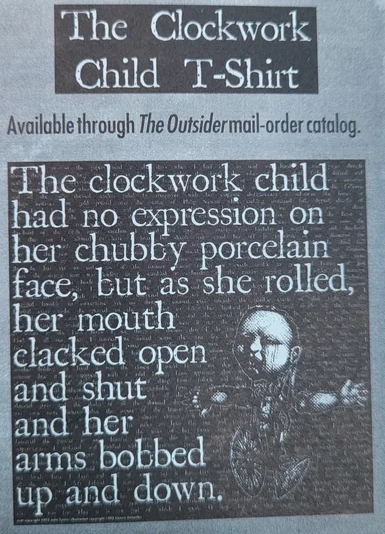 The Clockwork Child, which appears briefly in Countdown, became part of Pagan Publishing’s visual identity in the 90s and was much seen on tee-shirts. Its first appearance was in John Tynes’ short story ‘Ambrose’, and later reappears in other Delta Green publications including Insylum and Impossible Landscapes. Tynes reports that Ramsey Campbell bought a Clockwork Child shirt from him at a horror convention, and thus the circle is complete.
The solid gold goldfish that appears in ‘Night Corridors’ jolted my memory and I’m throwing open the question of whether the small statue of a golden rat with weird powers in Gradient Descent (discussed in s3e18 here) is a reference to this
Robert W. Chambers, repeatedly referenced in this episode and this page, was the author of The King in Yellow, a book of short stories published in 1895, which have subsequently become drawn into the orbit of the Cthulhu mythos. The book has nine stories: four are weird fantasy and concern the play ‘The King in Yellow’ that supposedly drives people either insane or into a different state of consciousness. The other five are set in Paris, one during the Siege of Paris (1870–71) and the rest in fin-de-siècle Paris, mostly among a community of bohemians and artists. The King in Yellow was Chambers’ second book: he went on to write two novels and story collections a year until his death in 1933 and rarely returned to the horror genre, which today is the only thing he is remembered for.
Lovecraft was an admirer of Chambers’ work and included him in ‘Supernatural Horror in Literature’, as well as putting references to the Lake of Hali and the Yellow Sign into ‘The Whisperer in Darkness’. Chambers had in turn taken elements from Ambrose Bierce, particularly Carcosa, Hali and Hastur.
 Neville Brody is a noted typographer and graphic designer who rose to fame in the 1980s and 1990s, with his avant-garde record sleeves (for Cabaret Voltaire, Clock DVA, Depeche Mode, Psychic TV, 23 Skidoo and many more) and logos for British magazines including The Face and Arena. As digital type design became a thing, his work led the charge, designed for desktop publishing and screen technology rather than being adapted from analog type styles, and was much imitated. His 1984 typeface Industria is the hero design element of the Delta Green game line.
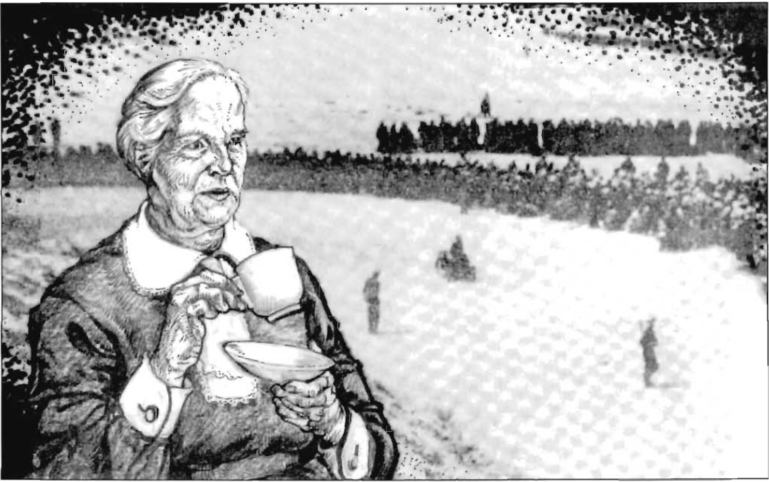 A moiré effect is where two patterns, in this case dot-screens, are overlaid and create visual interference. They have been a problem in printing for decades, and particularly crop up when scanning and then reproducing printed greyscale artwork, particularly with cheap or lower-resolution scanners. There are lots of fun animated gifs of the effect on the Wikipedia page for the subject. The image on the left is from Countdown, and you can clearly see the moiré pattern in the background (click to enlarge). High-quality scanners have largely eliminated the problem but you can still notice it from time to time.
Thank you for listening! The hosts of this episode were Ross Payton, Greg Stolze and James Wallis, with audio editing by Ross and show notes by James. We hope you enjoyed it. If anything in this podcast or these notes has spurred your interest then we invite you to come and chat about it on our friendly Discord.
If you click on any of the above links to DriveThruRPG and buy something, Ludonarrative Dissidents will receive a small affiliate fee. You will not be charged more, and the game’s publisher will not receive less, it’s a win-win-win. Thank you for supporting the podcast this way.