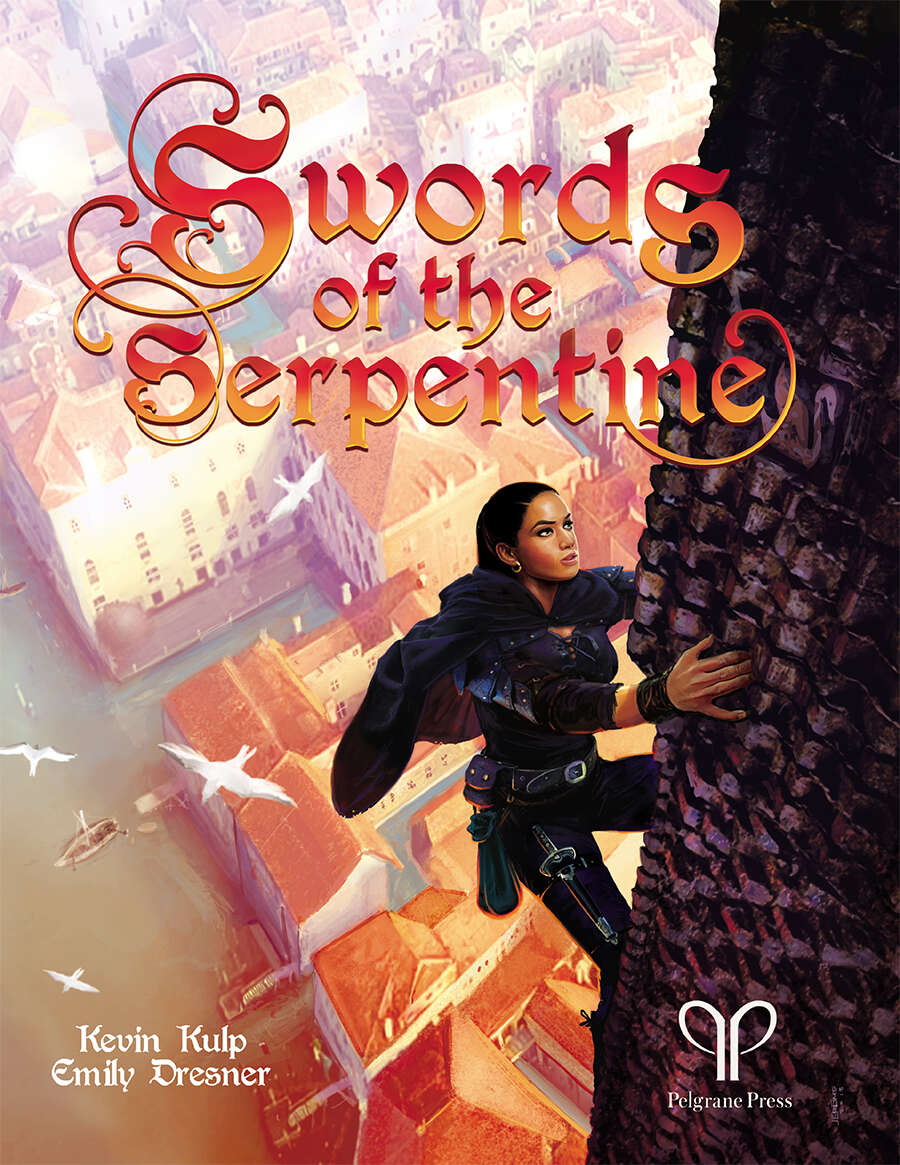
SWORDS OF THE SERPENTINE is a game of fantasy shenanigans in a labyrinthine sinking city populated by rogues, schemers, cultists, swashbucklers and your player characters, written by Kevin Kulp and Emily Dresner, and published by Pelgrane Press in 2022. It uses a variation of the Gumshoe system originally created by Robin D. Laws in 2007. The book has 396 pages.
“I’ve known designers who’ve used play-balance and they’re all cowards” – Greg
This episode exists thanks to the generosity of LND backer kvetch, who backed our season-three Kickstarter to add another episode, and then polled the LND Discord community to choose a new game for us to cover in it. Such kindness is humbling, and we are incredibly grateful for it.
SHOW NOTES
These are the notes for this episode, a chance for us to pick up the threads, fill in the blanks, throw up some links, and correct the occasional errors that we didn’t have time to deal with in the episode itself. Anything in yellow text is a clickable link.
Pelgrane Publishing was founded in 1999 to publish the Dying Earth RPG, based on the novels by Jack Vance. Pelgrane grew out of Profantasy Software, makers of the mapping software Campaign Cartographer. At the time they were sharing an office in south London with James’s company Hogshead Publishing (or rather, Hogshead was sharing with Profantasy, the latter having been there first. We were subsequently joined by Nightfall Games, meaning that you could have taken out 70% of the UK RPG publishing industry with a single packet of poisoned Hobnobs). James has continued to share offices with Pelgrane/Profantasy on and off ever since, and still lives a short distance from Pelgrane/Profantasy bossman Simon Rogers.
Gumshoe was not originally designed, whatever James says in the episode, for HP Lovecraft stories, it was designed for noir-style private-eye tales, hence the name, and the first published game using it was Esoterrorists. But there’s a considerable overlap between the two genres, and there’s no question that Gumshoe is best known as the engine behind Pelgrane’s Trail of Cthulhu. The trouble is there isn’t much market for straightforward private-eye RPGs, but the moment you add shoggoths your sales curve goes alpine.
‘Serpentine’ means snake-like, but is also the name of a lake in Hyde Park, in central London, which is why James’s pronunciation is correct.
James’s (short) reviews of Thieves World and TSR’s Lankhmar in Games International magazine, from 1989, are readable at Archive.org here.
Among the various inspirational sources and fellow travellers that we talk about for SotS, here’s some more data and links:
- Fafhrd and the Gray Mouser are characters – we hesitate to call them heroes – created by Fritz Leiber for a series of stories and novels, mostly set in the port-city of Lankhmar. Fafhrd is a very tall barbarian, the Gray Mouser is a thief, and the two are rogues. The stories began appearing in the 1940s but were not collected until the 1960s; they are the foundation-stones of this style of post-Conan fantasy adventure and are still delightfully readable today.
 Thieves’ World is a series of 12 shared-world anthologies edited by Robert Asprin between 1979 and 2004, with authors including Poul Anderson, John Brunner and C J Cherryh. All the stories are set in and revolve around the port-city of Sanctuary. The books were adapted into a highly regarded RPG box-set published by Chaosium in 1981, with generic game stats, by a veritable parade of top-level designers including Steve Perrin, Marc Miller, Ken St Andre, Eric Goldberg and Dave Arneson. See above for James’s review.
- The Thieves Guild RPG was published by Gamelords in 1980. The rules are heavily influenced by D&D though it removes many trad fantasy elements (monsters, magic). As an early example of a hyper-specialised RPG it’s of some interest, but if it’s coupled with the Gamelords setting The Free City of Haven it becomes something that was, by the standards of the early 1980s, really quite special.
- The Lies of Locke Lamora is a 2006 novel by Scott Lynch concerning a group of rogues who burgle and rob in a fantasy city based on medieval Venice. Many people have got a big kick out of it and its sequels, but James was not one of them.
- The Freeport series from Green Ronin is notable as one of the very first d20 supplements (Death in Freeport was released 10th August 2000 and went on to win the Origins and ENnie Award for Best Adventure). It combines the usual fantasy tropes and swashbuckling city filled with rogueish adventurers with elements of eldritch horror.
- Marienburg is a supplement for Warhammer FRP written by Anthony Ragan and released by Hogshead Publishing in 1999. It’s a port-city built on many islands, in this case closer to Rotterdam than Venice, but with all the elements you’d expect plus grimdark. Amazing poster-map by Ralph Horsley; CGI cover that has aged extremely badly. Probably the best WFRP book that Hogshead released. Subsequent publishers have done revised versions of it; I’ve no idea what they’re like.
- Chill is a Victorian gothic/classic horror game originally released as a boxed set in 1984 by PaceSetter, a group of ex-TSR employees who thought they could do better. Chill was their bestselling game but it wasn’t enough to keep the company afloat. Mayfair Games did a modern-day version in 1990 which stayed in print for about as long as Mayfair did; a third edition came out from Growling Door Games in 2015, and apparently a fourth is in the works.
- Delta Green is one of the touchstones of modern horror gaming, adding layers of conspiracy, bureaucracy and paranoia to the worlds of Call of Cthulhu. We have discussed it many times before, notably in season 1 episode 5.
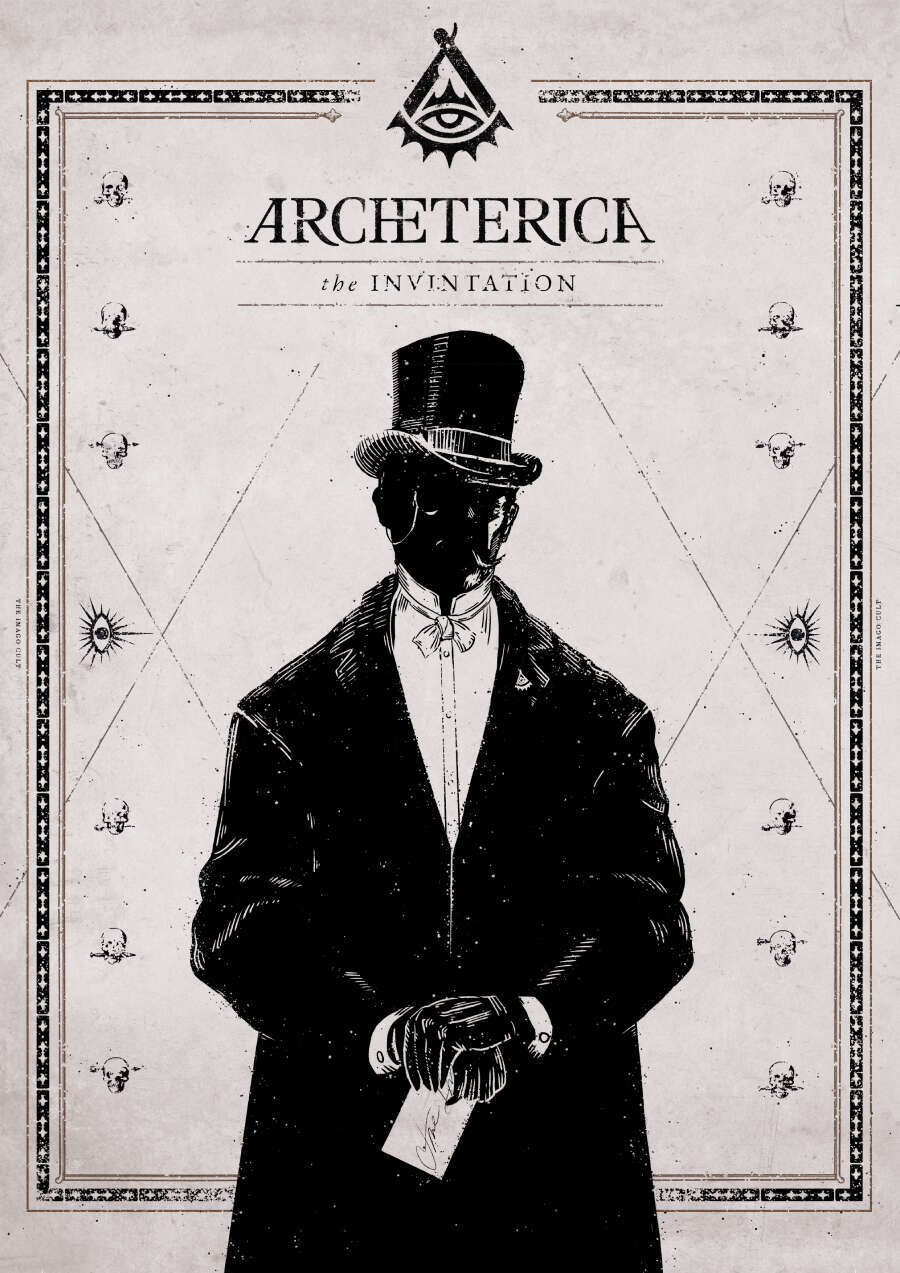
 Archeterica is a new arrival that James won’t shut up about: a beautiful Ukrainian horror-conspiracy game set in a magic-realist Victorian-style world, with fantastic production values and a unique tone. A strong recommend from LND, and a pay-what-you-want download on DriveThru.

Wyrd Science is a splendid quarterly roleplaying magazine now on its eighth issue, available in print and PDF form. With content mostly focused on newer games, it’s beautifully edited and laid out, with great art and excellent taste in columnists. Sometimes available as discounted PDF bundles of multiple issues.
VTTs are ‘virtual tabletops’ digital platforms for playing RPGs over the internet. Probably the best known is Roll20.
Masks of Nyarlathotep is one of the great Call of Cthulhu campaigns, and one of the great RPG campaigns full-stop. Released in 1984, it was co-written by Larry DeTillio (co-creator of He-Man and She-Ra) and Lynn Willis. A connected series of five, six or seven globetrotting adventures depending on which edition you play, it’s the template on which many subsequent CoC campaigns have been based.
The Ship of Theseus is a paradoxical thought-experiment: if every part of a ship is removed as it wears out and replaced by an identical new part, is it the same ship? (And, asked Thomas Hobbes some centuries later, what of a second ship made from all the parts that have been removed?) The idea was originally posed by Plutarch in his Life of Theseus, 23.1, in the first century CE. Real-world examples include the USS Constitution, of which as little as 10% is original these days, and the Ise Grand Shrine in Japan which is entirely rebuilt every two decades.
Lancer is an SF game of battling mecha-style giant robots, which we gave the Ludonarrative Dissidents treatment in season 1 episode 3.
Rifts is a science-fiction kitchen-sink of a game by Kevin Siembieda, which we ran through in season 3 episode 13.
The TV show Strange Luck, which Greg referenced, did not star Skeet Ulrich, but D. B. Sweeney. Broadcast on the same channel (Fox) in the timeslot immediately before the X-Files, the two are often confused.
Brindlewood Bay is a play-to-find-out RPG based loosely on Murder She Wrote, which we cast a magnifying glass over is series 3 episode 15.
Three Hearts and Three Lions by Poul Anderson is one of the fantasy novels that many D&D tropes were lifted from. Apart from that it’s a hoot: a WWII soldier on the point of death suddenly finds himself in a parallel Earth where magic and legends are real. Anderson might have been writing in 1961 but his stuff is still exceptional: many of the commonplace ideas in modern fantasy originated with him. and there’s even an argument that The High Crusade (aliens land in medieval England, knights capture their ship and fly to the stars to give the aliens hell) may have been an inspiration for Warhammer 40,000.
Metacurrencies are numerical game-systems that allow players to take control of elements of the story outside of their characters’ abilities – things like Fate Points. We did a whole episode about them in season 2 episode 4.
The ‘Four Questions’ that Greg mentions are the backbone of every episode of Ludonarrative Dissidents:
- What does this game do?
- How does it do it?
- How do people play it?
- Why do they play it that way?
Sometimes we wander away from this list, but they underlie all the questions we ask ourselves as we read through and test the games for the podcast.
Doom running on a pregnancy test.
The Gamist-Simulationist-Narrativist triangle (sometimes called GNS Theory) is something we’ve talked about before but it’s worth repeating. It’s a piece of RPG theory that came out of the deliberations on Usenet in the late 1990s, mostly devised and championed by Ron Edwards. Broadly, it says that every game and its rules are a combination of three types of design: gamist (playable/entertaining), simulationist (realistic), and narrativist (story), and can be plotted on a triangle. Scholars of RPGs consider it a bit old-hat these days but it’s a useful foundation for thinking about designs, particularly one’s own.
Kind Hearts and Coronets is a 1949 black-comedy film from Ealing Studios in the UK, following the life of Louis D’Ascoyne Mazzini as he murders his way through the family that disowned his mother, so he can inherit the dukedom. It is regularly voted one of the greatest British films ever made, it is 106 minutes of pure entertainment, and the ending is sublime. Alec Guinness plays all eight members of the D’Ascoyne family, one of the reasons that a generation of Britons regarded – and still regard – him as primarily a comic actor. The 2026 movie How To Make A Killing is an unsatisfactory remake.
Speaking of killings, Millennials are Killing is a short RPG by James D’Amato, a horror-comedy game in which the PCs are millennials who mostly want to destroy stuff. It is based on the Iron Heroes system, a D&D3e hack by Mike Mearls. Also, it’s a buck. How can you resist a pitch like that for a buck?
UPDATE! Shortly after these shownotes went live, Kevin posted on the Ludonarrative Dissidents Discord with his notes on the notes:
“As far as I know, the first GUMSHOE game was Esoterrorists (2006), which is investigative monster-hunting.
“The swamp city of Eversink was originally envisioned by me and put into my 2e AD&D campaign back in the late 90s (my first city that had multiple political factions), then brilliantly re-designed by Emily for this project.
“The idea for SotS came while walking my dogs and listening to a podcast with Epidiah Ravachol talking about his game Swords Without Masters. “I wish you could make a fantasy game with GUMSHOE, but the thing it does worst is combat,” I was thinking. Then I hit on how to solve that (Investigative spends boost damage and give more narrative control), and was so taken by the idea I missed two turns on my drive back home.
“You mention Hogshead’s Marienburg: Sold Down the River, by Anthony Ragan. This is the rpg supplement that taught me how fantasy cities should work and feel.”
Huge thanks to Kevin for that, and also for GMing the upcoming Actual Play episode.
Thank you for listening! The hosts of this episode were Ross Payton, Greg Stolze and James Wallis, with audio editing by Ross and show notes by James. We hope you enjoyed it. If anything in this podcast or these notes has spurred your interest then we invite you to come and chat about it on our friendly Discord.
If you click on any of the above links to DriveThruRPG and buy something, Ludonarrative Dissidents will receive a small affiliate fee. You will not be charged more, and the game’s publisher will not receive less, it’s a win-win-win. Thank you for supporting the podcast this way.