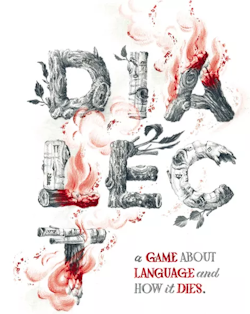
DIALECT: A Game About Language And How It Dies is a 2018 single-session RPG by Hakan Seyalioglu and Kathryn Hymes, published by Thorny Games. It’s a game about a small community, isolated from larger groups, that first creates its own verbal forms to describe its situation, and then must adapt or lose them as the community reacts to external threats. It is critically acclaimed and a winner of multiple awards.
“There are two kinds of roleplaying games: roll high to do more damage; and write sad feelings on an index card.” – Greg.
(We don’t actually know who said this first, but we think it dates to the era of storygames.com in the early 2010s. The website still exists but is much changed, and doesn’t have forums any more.)
SHOW NOTES
These are the notes for this episode, a chance for us to pick up the threads, fill in the blanks, throw up some links, and correct the occasional errors that we didn’t have time to deal with in the episode itself. Anything in yellow text is a clickable link.
This is Greg’s episode, where he gets to choose the game we cover. Each of the hosts gets one per season: Ross’s was Rifts, James’s was Maelstrom, and Greg took a long time to make his mind up, which is why this is episode 25.
Thorny Games is Hymes’ and Seyalioglu’s own company, set up to release their games, including (as of this writing) Signs, ‘a game about being understood’ and Xenolanguage, ‘A game about alien language and human memory’. Their website does not list the years the games were first published: bad academics, no cookies.
Wall-E is the 2008 Pixar movie where a small sad robot is left behind on Earth to tidy it up after all the humans have fucked off.
CES, the Consumer Electronics Show, is an annual trade show in Las Vegas where many new tech products and consumer hardware are launched, much of it never to be seen again. In the heyday of the web and the new-tech boom at the start of the century it was one of the most vibrant, exciting and extraordinary weeks in the world, if you could get past the bullshit and the internet-enabled fridges, which 25 years later are still not a thing anyone wants.
Dialect says it’s about a language (well, okay, it just says ‘language’ without the indefinite article but within that omission it’s having its cake and eating it) but in fact it’s about an argot or a cant, ‘the jargon or language of a group’, since the majority of the language your characters will speak is the one the players have in common, interspersed with the words you create.
 Microscope is a 2011 single-session GM-less story-game with RPG elements, created by Ben Robbins. Players collectively define and describe an imaginary timeline of events, with the ability to add new events between existing ones, or define parts of the timeline in greater depth. Hugely influential, particularly on games like I’m Sorry, Did You Say Street Magic?, which also has themes of colonialism and colonialist history. It is mentioned in the Dialect bibliography, which weirdly isn’t the case for…
Dog Eat Dog, Liam Liwanag Burke’s brutal and brilliant 2012 game of colonisation, nominated for the Diana Jones Award. All players play natives apart from the richest, who plays the forces of colonisation. It’s probably closer to Dialect than Microscope is: you know your character is going to have a bad time and the ending will be sad, but the gameplay is fascinating and the experience is revelatory. It’s been compared to the Stanford Prison Experiment. The game is not currently available but it’s coming out in a new edition in 2027 from Central Michigan University Press, as part of their ‘Art & System: Games for Expanded Play’ series (currently at three titles: Dog Eat Dog, Princess With A Cursed Sword, and the Mountain Witch.
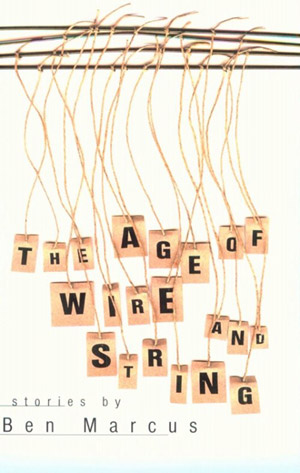 The Age of Wire and String is a 1995 novel (or collection of 41 very short stories) by the experimental novelist Ben Marcus, in which language itself is malleable and playful. Wikipedia says it ‘combine(s) technical language with lyrical imagery to form a sort of Postmodern catalog by turns surreal, fantastic, and self-referential’ but don’t let that put you off. If you like a challenging read that makes you reconsider the nature of words themselves then this is that. Think House of Leaves meets Pontypool.
James mentions ‘sleeving’ cards as a way of making a set of Dialect cards. This is a technique borrowed from card-game prototyping: buy a box of medium-thickness card sleeves of the kind that CCG players use to protect their cards in play, and put slips of paper – in this case print-outs supplied in the PDF and cut down to size – into them, to make a deck that’s a uniform shape and easily shuffled. After the game the sleeves can be reused for another project.
Circles and rituals in games: in the recording James fails to mention the Magic Circle, which is weird because he takes every other opportunity to bang on about it. Quick version: Johan Huizinga‘s hypothesis, introduced but not really explored in his 1939 book Homo Ludens, that play creates a shared mental space separate from the real world, subsequently expanded by Eric Zimmerman (who James knows, drink) and Katie Salen in their 2003 book Rules of Play: Game Design Fundamentals, mostly in the context of video games, and then by Edward Castronova in Synthetic Worlds: The Business and Culture of Online Games (2005), which ditto. Incredibly powerful concept, a key part part of what makes play and games so potent. The Wikipedia page is a decent jumping-off point for further exploration.
Tigers Are Not Afraid, referenced by Greg and Ross, is a 2017 film from Mexican director Issa López. Rotten Tomatoes says, “Tigers Are Not Afraid draws on childhood trauma for a story that deftly blends magical fantasy and hard-hitting realism – and leaves a lingering impact.”
Ten Candles, referenced by Ross, which it turns out none of the triumvirate has played, is a much-lauded horror game of a world falling into darkness, with the titular ten candles as a core component as they extinguish one by one. Written by Stepen Dewey in 2015, it’s one of very few truly original RPG designs.
It is not to be confused with Waldschattenspiel, another candle-based game, this one a 1985 German board game of hunting gnomes in the woods by night: gnomes hide in the shadows behind trees, the players move the candle to move the shadows and expose the gnomes. Delightful concept, slightly lacking in its execution.
Birthright, the D&D setting referenced by Greg, was designed by Rich Baker and Colin McComb, and came out in 1995 as part of the 1990s wave of clever, imaginative takes on ways and worlds to play with D&D, most of which were so badly budgeted that TSR lost money on every copy sold. Others include Planescape, Dark Sun and Spelljammer. The setting casts player-characters as the divinely empowered rulers of the continent of Badname, on the world of Longerbadname, and deals with nation-building, diplomacy and war.
Grey Ranks is another RPG of doomed player-characters, except these ones were involved in the real-world Warsaw Uprising of 1944. It was designed by Jason Morningstar and published by his Bully Pulpit games imprint in 2007. It won the Diana Jones Award, sharing the victory with Wolfgang Bauer and Open Design. The fact that it is only an Electrum-level seller on DriveThruRPG should be regarded as a war crime.
The other game that succeeds when you forget it is, of course, The Game, the canonical un-game. We will not explain it here, and you should be grateful for that. No DriveThruRPG link for this one.
The XKCD ‘average familiarity’ cartoon.
For a long time Chivalry and Sorcery was the byword for RPGs that were over-mechanical to the point of unplayability, along with its FGU stablemate Aftermath, which used different but similarly unnecessarily complex first-generation mechanics. We are almost fifty years on since then, C&S 5e has been in print since 2020, it is now streamlined and approachable, and does, in fact, have a well-reviewed set of quickstart rules.
The ‘Dancing Dog’ standard – the Samuel Johnson quote Greg mentions is “Sir, a woman’s preaching is like a dog’s walking on his hind legs. It is not done well; but you are surprised to find it done at all.” The saying was recorded by Johnson’s companion and biographer James Boswell on July 31, 1763, only a couple of months after they first met.
Streatham Park, mentioned by James, was the home of Henry and Hester Thrale in the mid to late eighteenth century, where they played host to many of the most notable artists, playwrights, novelists, actors and journalists of the age, including Samuel Johnson. The group has become known as the Streatham Worthies, after a series of paintings of them created by Sir Joshua Reynolds, one of their number. The house was torn down in the mid-1800s, a mulberry tree known as Johnson’s Mulberry blew down a couple of decades ago, and nothing physical of its history remains apart from a couple of street names. The other thing to note is that despite its name, it is in fact in Tooting, not Streatham.
The first female Archbishop of Canterbury and Primate of All England, mentioned by James, is Dame Sarah Mullally, installed in January 2026. So far the church has not schismed over it, but give them time and a couple of bottles of communion wine and who knows.
The Tynes effect, the tendency to assume that anything released for Delta Green was written by John Scott Tynes, is something we have referred to throughout this series. As far as we know he was not involved with Swords of the Serpentynes.
Thank you for listening! The hosts of this episode were Ross Payton, Greg Stolze and James Wallis, with audio editing by Ross and show notes by James. We hope you enjoyed it. If anything in this podcast or these notes has spurred your interest then we invite you to come and chat about it on our friendly Discord.
If you click on any of the above links to DriveThruRPG and buy something, Ludonarrative Dissidents will receive a small affiliate fee. You will not be charged more, and the game’s publisher will not receive less, it’s a win-win-win. Thank you for supporting the podcast this way.